Sittard-Geleen's Common Ground journey: nine years of taking steps
Talk to the team at the municipality of Sittard-Geleen about Common Ground today and you'll likely think: they're really far ahead. And they are, but it wasn’t an overnight success. It's the result of nine years of hard work, planting seeds, and taking one step at a time.
How it started in 2017
By 2026, there's no escaping the subject of digital autonomy and sovereignty. The past year gave us all a rude awakening. In Sittard-Geleen, though, a handful of people were already thinking about it back in 2017. With the Common Ground programme freshly announced, the timing was perfect to start raising awareness, to create the realisation that change was necessary.
The Common Ground movement really took off five years later, driven by the ambition to build a 'My Municipality' citizen portal on open-source components and connected to Common Ground.
There was a catch: Sittard-Geleen had no Haven environment (the standard for cloud-independent hosting), and a citizen portal only added real value if other components were rolled out and connected alongside it. The easy conclusion would have been that it was simply too early. But the team asked a sharper question: if not now, then when exactly? To get the project moving anyway, they deliberately signed short contracts with their existing suppliers and simply got started.
From building their own apps to integration
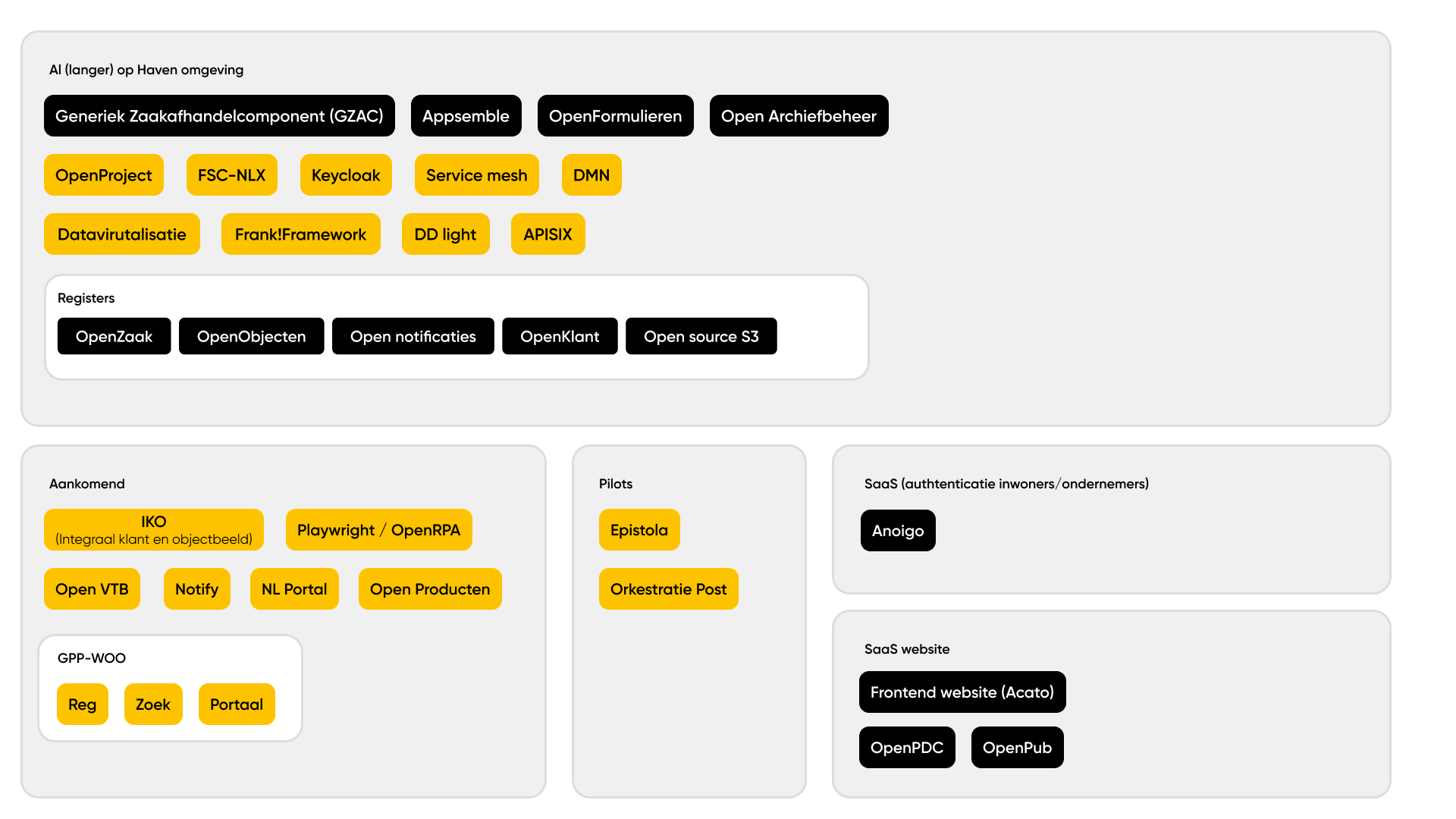
Where did they begin? With Appsemble, among other things. On this open-source, low-code platform, the municipality builds simple applications itself. These apps support, for example, logging and handling the phone notes from the customer contact centre. With no Haven environment in place yet, Appsemble was used as SaaS.
Around the same time, the existing integration platform was due for replacement. Here too, Sittard-Geleen deliberately chose an open-source platform that connected to Common Ground: the Frank!Framework, replacing Adeptia.
And in the summer of 2023, they began working with data virtualisation through Apache Drill. With help from WeAreFrank! and a pragmatic mindset, it was hosted externally at first, simply so they could get going.
That's how Sittard-Geleen refused, and still refuses, to be held back by less-than-perfect conditions. Their approach proves what’s possible with a bit of creativity. Once the snowball starts rolling down the hill, it grows a little bigger with every turn.
A continuous process
After four years of Common Ground work, a good number of components now run on the municipality's own Haven environment. Not just Appsemble, the Frank!Framework and data virtualisation, but new elements too, including numerous registers and components such as GZAC, FSC-NLX, OpenFormulieren and APISIX.
In 2026, more components are still being added and several pilots are under way. Meanwhile, a few open-source components continue to be used as SaaS, such as the authentication platform for residents and businesses and a part of NL Notify.
Wind in the sails: the municipal information strategy
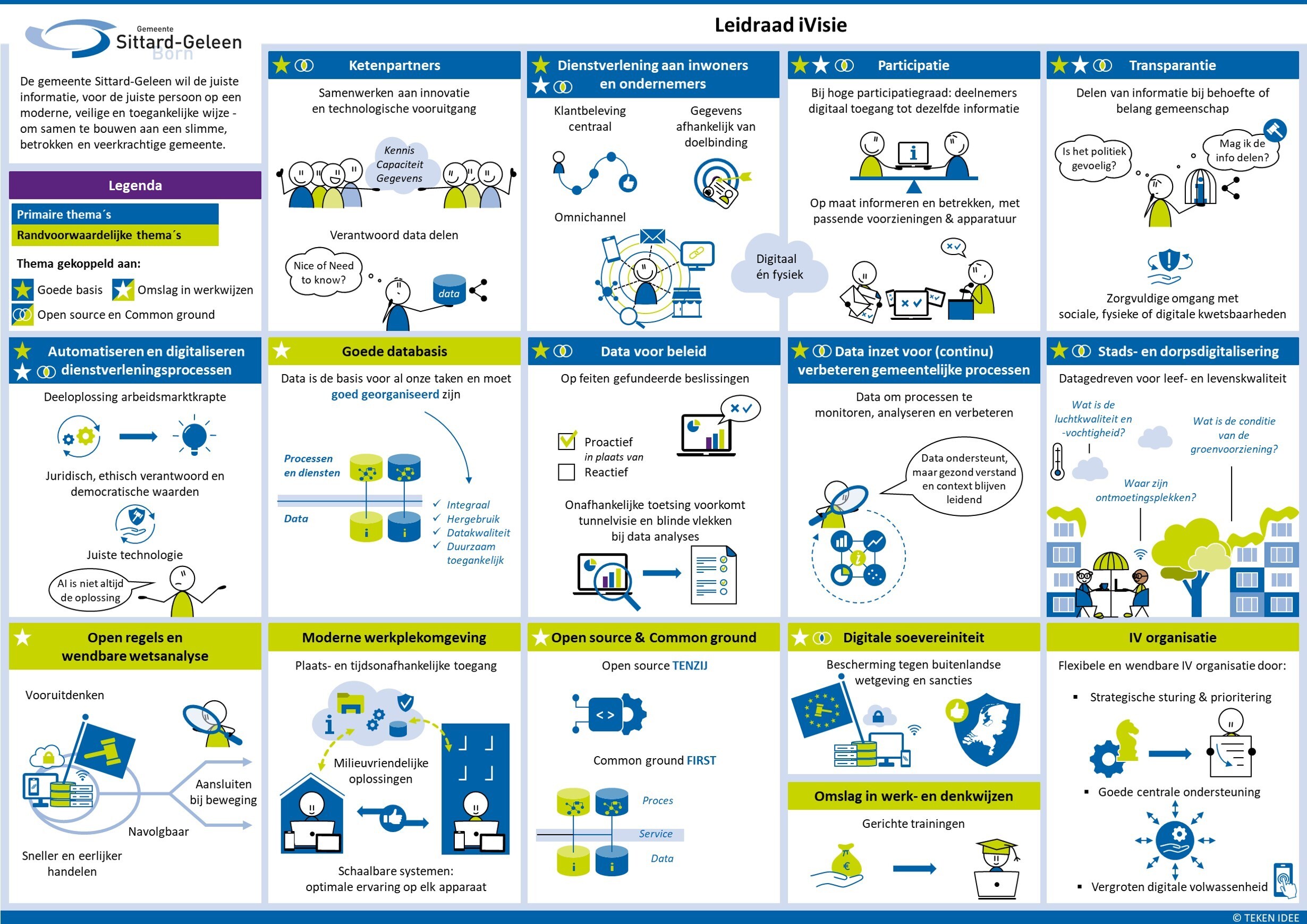
In 2025, the Common Ground team got an extra boost with the introduction of the municipal information strategy. Its priorities of 'Open source & Common Ground' and 'Digital sovereignty' tie directly into the move towards Common Ground. On top of that, Common Ground is a precondition for ten of the strategy's fifteen points.
Now that Common Ground and open source are anchored in a multi-year information strategy, the project also has a clear sponsor higher up in the organisation.
One step further, every time
The arrival of the information strategy doesn't mean Sittard-Geleen has switched over to Common Ground completely and all at once. The shop has to remain open, there are existing contracts, and not every application is ready. But wherever it fits, and wherever there's a natural moment to switch, that opportunity is taken.
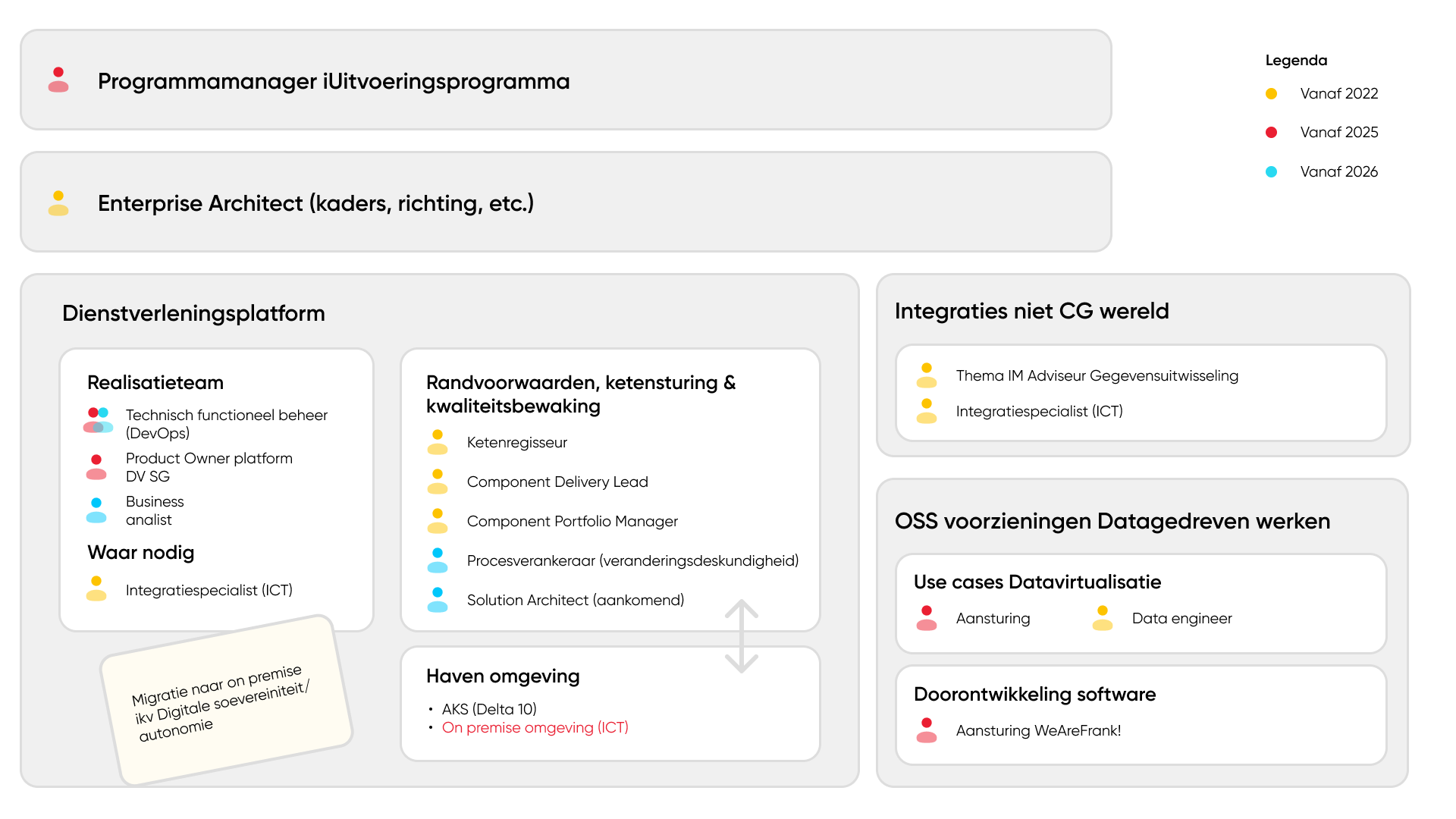
The same pragmatic approach applies to how the Common Ground team itself is put together. Look at the team now and it seems like a lot of people. It may sound familiar, this too happened step by step.
When work on Common Ground started in 2022, roles were mostly added to existing jobs. The municipality's enterprise architect and integration specialist simply began spending more of their time on Common Ground. The team did quickly gain a process coordinator, who has an overview of all the components and connections.
Once the information strategy was adopted in 2025, more people joined the team. A programme manager came on board to deliver the strategy, and the technical side was professionalised by bringing in DevOps and a product owner from within the existing organisation.
Where hosting of the Haven environment was initially outsourced to an external party, the municipality is now migrating to an on-premises Haven environment. That way it keeps genuine control over its own data and becomes digitally autonomous and sovereign.
Resistance and pushing through
None of these steps happen on their own. There has certainly been internal scepticism about the developments, and in some areas that scepticism is still there. The people driving it forward also have a job to do in bringing the organisation along. Because in the end, the municipality reaps the rewards when it comes to control, direction, cost and functionality.
The challenges with data
One of the next big steps is data virtualisation. In the spirit of Common Ground, the aim is to get data straight from the source.
Ten years ago, that was far from reality. The data warehouse was full of copied data. And there wasn't even a single data warehouse: Social Affairs had its own, Fer served as a central BI data warehouse, and map data lived in yet another separate store.
The arrival of a new BI product alongside the existing one was a reason to look for a better way to unlock data, not least because of the realisation that switching BI products meant rebuilding all logic from scratch.
On top of that, Sittard-Geleen wanted a faster time-to-market for making new data available.
Looking ahead, they also expected far more data, and new kinds of it, think of sensor data from smart-city projects. They wanted to be able to combine all these new sources and data types in one central place.
Data virtualisation
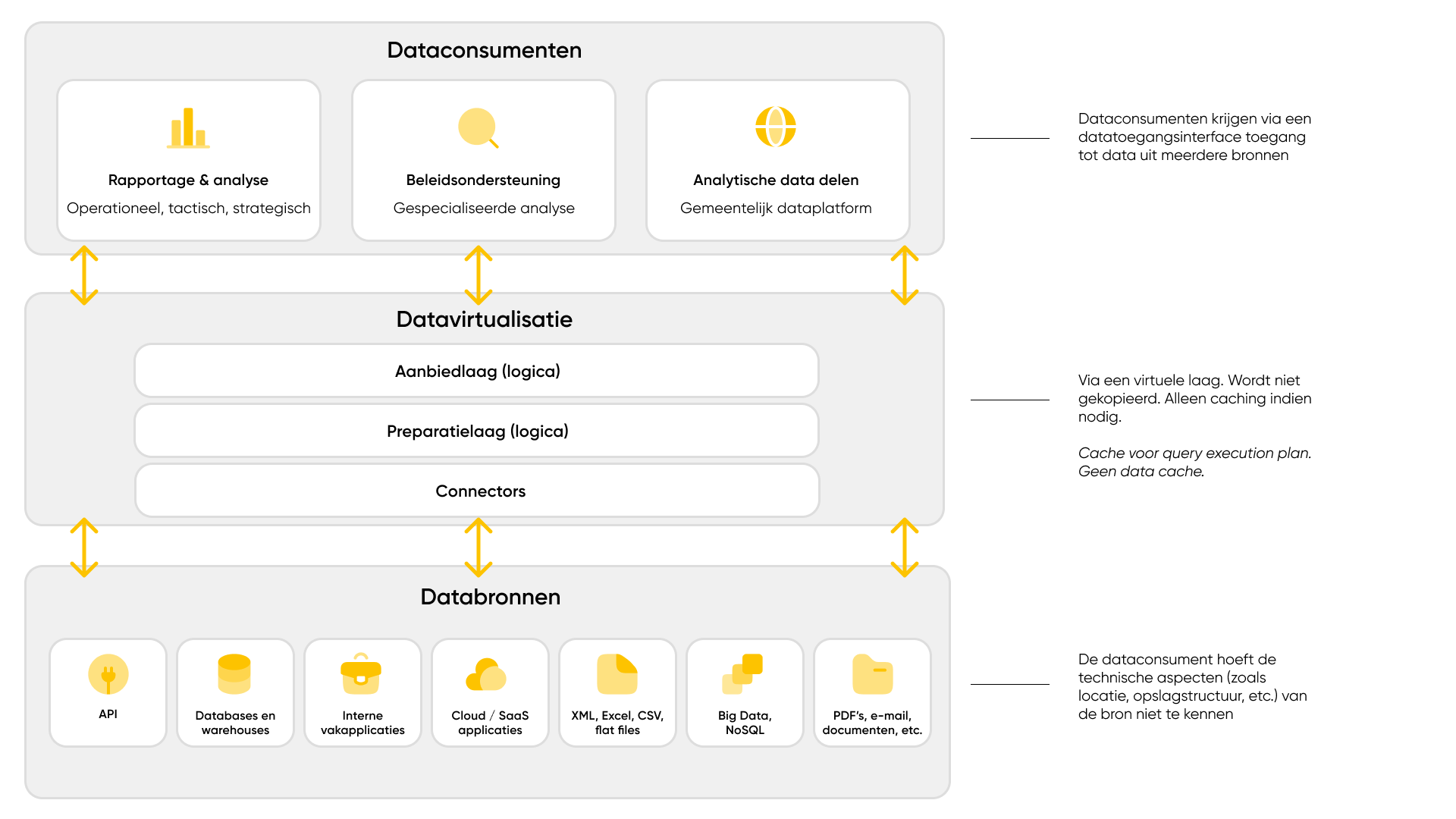
With data virtualisation as a layer between data sources on one side and BI tools and data consumers on the other, that central place was found. Instead of storing data centrally, data virtualisation queries every source separately while still presenting the data in a single, unified view.
The beauty of data virtualisation is that it can unlock virtually any file type and data format, from data warehouses to SaaS applications, and from big data and NoSQL to CSV files.
For the people building dashboards, data virtualisation is the intermediate layer that brings all the data together in one view. You pull data from the source, there's no need to copy it, and you're not tied to specific data sources or BI tools.
Data virtualisation was a journey too
In 2020, Sittard-Geleen looked at the best way to tackle its data challenges. Alongside data virtualisation, it considered data warehousing, a data lake and data mesh.
Data virtualisation emerged as the most promising direction, and a proof of concept in 2022 confirmed it. Within three days, several use cases had been worked out in which data was fetched at the source and displayed in different BI tools.
It sounds like a no-brainer, but continuing with data virtualisation was anything but. There was no ready-made Common Ground or open-source application available, and the one open-source option they did find had no active community behind it.
So Sittard-Geleen suddenly had to start developing software itself. Through a public tender, WeAreFrank! came on board as development partner. The choice ultimately fell on Apache Drill, a widely supported and well-developed open-source application for data virtualisation.
Data virtualisation and the Municipal Data Model
Given the rise and ‘gold’ Common Ground status of the Municipal Data Model (Gemeentelijk Gegevensmodel, GGM), connecting data virtualisation to it properly was a requirement from the very start. The catch is that the GGM's data storage and query toolbox are geared mainly towards 'traditional' data warehousing.
To bridge that, an approach was developed using SQL queries and configuration for Apache Drill, based on the GGM. Far from all GGM's sources have been unlocked, but a first step has been taken. And entirely in the spirit of Common Ground, it's publicly and openly available on GitHub.
The dream and the future of data virtualisation
With data virtualisation, Sittard-Geleen wants to create a single point of access for unlocking data and applying logic. The result is flexibility, efficiency and quality. Data virtualisation also makes it possible to use real-time data for analysis and visualisation. New data sources are easier and faster to unlock, and all kinds of data and sources can be connected, all in line with the principles of Common Ground.
Sittard-Geleen is now working hard to bring the first use cases into production, so that data use, too, becomes more digitally autonomous.
The ultimate dream is for the product and the GGM setup to be used more widely and developed further together with other municipalities.
Are you interested in data virtualisation? Get in touch with us for a demo and see how you, too, can unlock and use data more easily and quickly.
Questions about this case?
Get in touch