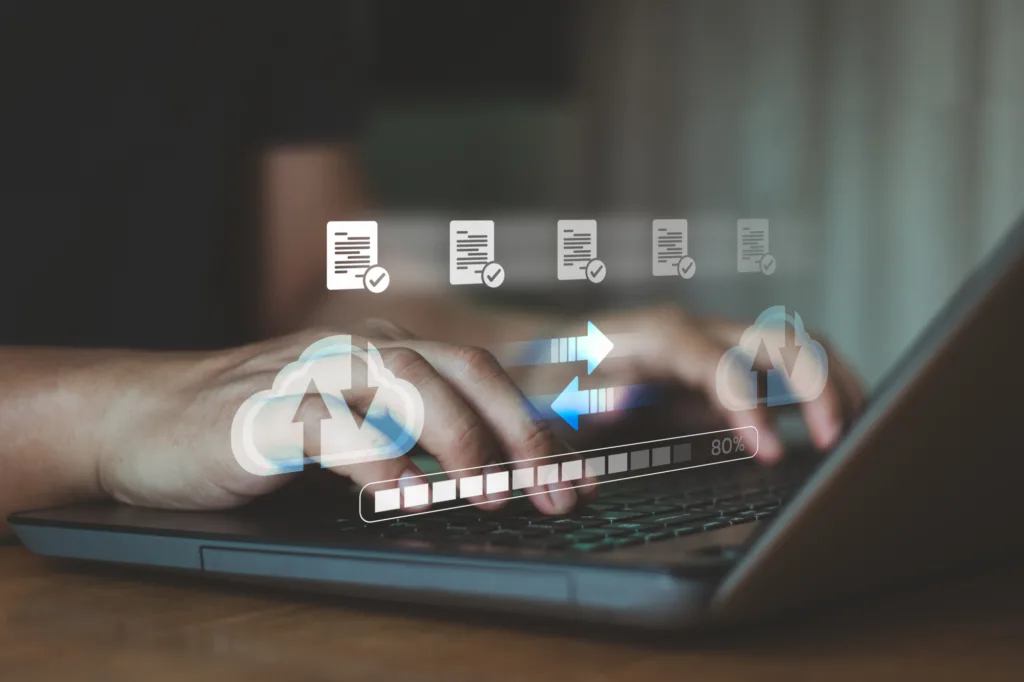
Migration made ease: Upgrade your ERP, Integration Platform, or Backend without downtime
As a CEO, I’ve often seen how daunting a major IT migration can feel. Companies dread replacing their trusted ERP systems or complex back ends, fearing disruptions to daily operations. That fear is valid. after all, these systems often underpin the entire business and have been running for years. But here’s the good news: it is possible to migrate without your business ever noticing a thing.
In this blog, I’ll explain how our Frank!Framework and the migration expertise of WeAreFrank! make this possible. Put simply, we place a decoupled integration layer between your systems. This allows both the old and the new solutions to run in parallel, communicating seamlessly without causing any disruption for users. I’ll refer to a real-world example: the migration from Tibco BW5, an aging integration platform. And show how we provide trust and clarity at every step of the journey.
Integration doesn’t have to be complicated
Application, data, and system integration may sound complex and expensive, but it doesn’t have to be. The Frank!Framework is a modern integration platform, a central layer that connects all your business applications and databases. Think of it as a universal translator or smart adapter: every system (ERP, CRM, or even custom-built applications) communicates with the rest of your landscape through the Frank!Framework. Because all traffic flows through this layer, systems don’t need to be directly connected, which means changes in one system won’t immediately impact others.
Open-source and flexible: The Frank!Framework is open source, no costly licenses or vendor lock-in, so you remain in control. It also includes more than 100 ready-to-use components (connectors for widely used protocols, databases, and systems), meaning we can build integrations faster and with fewer errors. The result is a secure, stable, and future-proof platform designed to make your business systems work together seamlessly.
Running old and new systems in parallel
One of the biggest advantages of a decoupled integration layer is that old and new systems can run side by side. Let’s say you’re replacing your legacy ERP. Instead of flipping the switch on a risky “big bang” cutover day, we connect both the old and the new ERP systems to the Frank!Framework. During the migration, both can exchange data with the rest of your applications.
In practice, this means the new system can be implemented and tested gradually while the old one continues to function. End users and customer processes remain unaffected. In multiple projects, we’ve kept older integrations (like SOAP and JMS connections) alive while quietly introducing modern REST APIs in the background.
Legacy applications kept running as usual, even as the rest of the infrastructure modernized, without interruption for end users. This parallel approach gives peace of mind: IT teams can configure and fine-tune the new solution without time pressure, only phasing out the old environment once the new one is fully stable. That’s the key to a smooth transition without downtime or data loss.
Use case: Migrating from BW5 without disruption
Take a recent example: we helped a multinational replace its outdated integration platform, Tibco BusinessWorks 5 (BW5), with the Frank!Framework. The reasons were clear: BW5 was end-of-life, support was fading, and license costs were high. Beyond modernization, the migration promised savings of around one million euros. But the complexity was daunting. Three business units, thousands of users, and hundreds of integrations depended on BW5.
Our approach was step-by-step and proven. In under a year, we migrated more than 100 integration components (representing several thousand connections) to the Frank!Framework, without downtime. The old Tibco environment and the new Frank!Framework environment ran in parallel, so we could thoroughly test each connection before switching over.
The result: operations continued without disruption, and services remained fully available throughout. Of course, large migrations are inherently complex, and unexpected issues can always arise. But by providing enhanced support during go-live, we addressed any hiccups immediately. That extra vigilance often makes all the difference.
This migration also showed how modernization can be more than just risk management—it can be an opportunity. In one business unit, we cleaned up data models and strengthened the infrastructure. In another, we modernized integrations by making them cloud-ready and moving from SOAP to REST APIs, all while keeping legacy interfaces accessible. Migration, in other words, can also be a chance to improve and innovate without threatening business continuity.
Trust Through Clarity and a Proven Process
Success in migration depends on preparation and process. At WeAreFrank!, we’ve developed a standard migration approach that builds confidence before the technical work even begins. Transparency is the key. We always start with a thorough analysis of the existing landscape. Using our Frank!Analyzer tool, we scan all current connections to map out complexity and risks. From there, we deliver a tailored business case and migration plan. Complete with clear timelines and budgets, so clients know exactly what to expect.
Implementation then proceeds in phases. We build integrations in a modern CI/CD environment and apply a factory approach to efficiently convert connections at scale. Many routine conversions are automated, while our experts handle the complex cases manually. Throughout this stage, old and new platforms run in parallel.
Constant testing is critical. With our unique Proof of Migration tool, we can automatically test up to 95% of all connections, verifying that every function works exactly as before. This ensures business operations continue smoothly throughout the project.
And after go-live, we don’t just walk away. In the handover phase, we train your team via the Frank!Academy so they’re ready to manage the new environment independently. Knowledge transfer is essential to help organizations get the most from their modernized platform.
Conclusion: Facing the Future Without Fear
My message to any organization facing a major migration is simple: it can be done without worry. By using a decoupled integration layer like the Frank!Framework and relying on an experienced migration partner, you can replace legacy systems without disrupting daily operations. We’ve done this dozens of times and consistently delivered on that promise.
The outcome is a more modern, agile IT landscape, without downtime or data loss. Integration and migration don’t have to be costly or complex; with the right approach, they become controlled, transparent projects.
As a CEO, I’ve seen firsthand how liberating it is for organizations to finally leave outdated systems behind while everything keeps running. My advice: embrace the possibilities of a modern integration framework and a partner who knows what they’re doing. Suddenly, that intimidating migration becomes not just manageable, but a smart investment in your company’s future.
A decoupled integration layer acts as a buffer between all systems. This allows old and new solutions to run in parallel without disrupting daily processes. The Frank!Framework ensures that every application keeps communicating, regardless of what changes behind the scenes.
Questions about this case?
Get in touch